

 Türkçe
 English
KVKK FROM A CORPORATE GOVERNANCE PERSPECTİVE: THE NECESSİTY OF INTEGRATİON
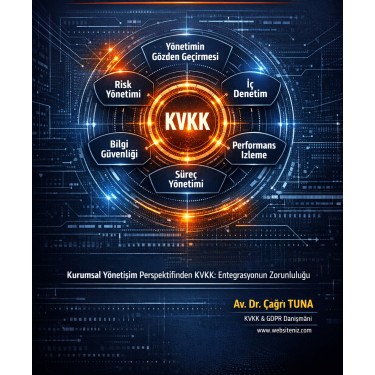
KVKK compliance is not merely a legal project.
It is a management system design.
Today, many companies believe they have fulfilled their data protection obligations by preparing policy documents, publishing privacy notices, and drafting certain procedures. However, this approach treats data protection law as a normative regulatory requirement, without positioning it as an integral component of corporate governance architecture.
The reality is this: personal data processing activities penetrate every operational layer of a company — from human resources to procurement, from sales to security, from customer management to digital infrastructure. Therefore, compliance cannot be achieved through the mere existence of documentation; it requires planning, monitoring, measuring, and auditing these activities within the management system itself.
Even organizations operating under ISO-based management systems carry a structural gap if personal data protection is not integrated into their existing systematic framework. A data protection approach that is not connected to quality management, risk management, internal audit, and continuous improvement mechanisms is not sustainable.
The core issue is simple:
Data protection compliance is not a separate workstream; it is a horizontal component of corporate governance.
This article aims to demonstrate why data protection is not a “legal file” but a “management system requirement,” and why integration is no longer optional but has become a mandatory governance standard for organizations.
1. The Management System Nature of Data Protection
Data protection law is not merely a normative field regulating processing conditions. It is also a governance discipline that reshapes the internal control architecture of organizations.
When the legal framework and international data protection approaches are examined, a systematic structure becomes visible:
- risk-based approach
- accountability principle
- technical and organizational safeguards
- breach management
- documentation obligations
- audit and reporting responsibilities
All of these are classical components of a management system.
In other words, data protection law inherently enforces the Plan – Do – Check – Act (PDCA) cycle.
Many companies interpret their obligations through a documentation lens while neglecting the systemic dimension of compliance. Yet personal data processing directly interacts with processes, roles, authority matrices, records, measurement tools, and audit mechanisms.
If an organization:
- does not maintain an up-to-date processing inventory,
- does not connect risk assessments to operational workflows,
- does not measure and log access authorizations,
- does not test breach scenarios,
- does not monitor performance at management level,
then what exists is documentation — not compliance.
The essence of data protection is accountability. Accountability is only possible through a measurable, traceable, and auditable system.
For this reason, data protection must be addressed not as a standalone legal file but as an integrated management discipline embedded within risk management, internal audit, performance measurement, and management review mechanisms.
Otherwise, compliance becomes a paper-based structure remembered only during crises — never internalized into daily operational reflexes.
2. Why a Separate Data Protection Structure Is Not Sustainable
A significant number of companies position data protection efforts as a compliance folder separate from their core management systems. Policies are drafted, privacy notices are published, retention schedules are created — and the process is considered complete.
This approach is unsustainable for three fundamental reasons.
2.1. Data Protection Is a Process, Not a Document
Personal data processing is dispersed throughout the organization — HR, procurement, sales, security, IT, contract management.
It is embedded within operations.
An obligation embedded in operations cannot be managed outside operations.
If data protection:
- is not integrated into process maps,
- is not embedded in risk analysis matrices,
- is not included in internal audit programs,
- is not placed on management review agendas,
then sustainability cannot be claimed.
2.2. Accountability Requires Management-Level Oversight
One of the fundamental principles of data protection law is accountability. This principle requires not only compliance but demonstrable compliance.
Within a management system logic:
- What is not measured cannot be managed.
- What is not monitored cannot be controlled.
- What is not audited cannot be sustained.
If performance indicators are undefined, breach management scenarios are untested, access rights are not periodically reviewed, and data subject requests are not metricized, a company may assume compliance — but cannot prove it.
In modern data protection practice, the primary risk is not the breach itself; it is the failure to manage the breach.
2.3. Contractual and Institutional Risk Dimension
Data protection obligations are no longer purely statutory — they are contractual.
Corporate clients, public authorities, and international business partners now assess data protection maturity during tender and contract negotiations. The question is no longer “Do you have a policy?” but “How does your system operate?”
A compliance file disconnected from processes, a risk analysis detached from operations,
a policy set unsupported by audit, does not generate institutional trust.
Data protection compliance directly affects brand reputation, contractual reliability, and operational continuity.
For this reason, data protection must not be structured as a parallel system; it must be embedded within the organization’s management architecture. Any alternative approach creates legal and operational fragility.
3. The Integration Model: Positioning Data Protection Within the Management System
Sustainable and demonstrable compliance requires not additional documentation but a holistic integration model embedded within management system architecture.
This model rests on five core pillars:
3.1. Risk Integration
Data protection risks must be incorporated into the corporate risk map.
3.2. Process Integration
Compliance must be embedded within operational workflows — not added externally.
3.3. Audit Integration
Data protection must be included in internal audit programs and corrective action systems.
3.4. Performance Integration
Compliance must be measurable through defined performance indicators.
3.5. Management-Level Integration
Data protection must be addressed in management review meetings and strategic oversight mechanisms.
When integrated, data protection ceases to be a legal topic confined to a department and becomes an executive-level governance responsibility.
4. Why This Model Is Not a Preference but a Necessity
Digitalization, increasing data volumes, stricter contractual obligations, and regulatory scrutiny have transformed data protection from a technical compliance issue into a governance imperative.
Today, data protection is:
- a component of corporate governance,
- a foundation of contractual trust,
- central to reputation risk management,
- integral to operational sustainability.
Organizations that fail to integrate data protection into their management architecture create dual systems:
- The real operational system
- The compliance-on-paper system
This duality is unsustainable.
Integration aligns compliance with operations, transforms legal obligations into management practice, and builds an auditable and measurable data protection structure.
5. Conclusion: The Place of Data Protection Within Corporate Architecture
Data protection compliance is no longer a peripheral regulatory task. It has become an essential layer of corporate governance.
Personal data processing is embedded across virtually all operational processes. Treating compliance as an isolated policy set inevitably creates a gap between documentation and practice.
Sustainable compliance requires integration into risk management, operational planning, internal auditing, and management review mechanisms. Only then does data protection evolve from a static obligation into a measurable, monitored, and continuously improved governance process.
Data protection should not be viewed merely as an administrative fine risk. It directly impacts contractual security, institutional reputation, stakeholder trust, and operational resilience.
Ultimately, data protection either integrates into the management system or remains structurally weak.
When integrated, it ceases to be the responsibility of a legal department and becomes a shared organizational discipline — generating not only regulatory compliance but structural strength, auditability, and institutional maturity.
In the coming years, companies will not be distinguished by whether they process personal data — but by how systematically they govern it.
From a corporate governance perspective, data protection is no longer a subheading. It is a foundational layer of corporate architecture.
Integration is not a preference. It is the natural outcome of sustainable management.
Av. Dr. Çağrı TUNA
KVKK & GDPR Consultant